
OSHA Edge Protection Requirements: A Practical Guide for Site Managers
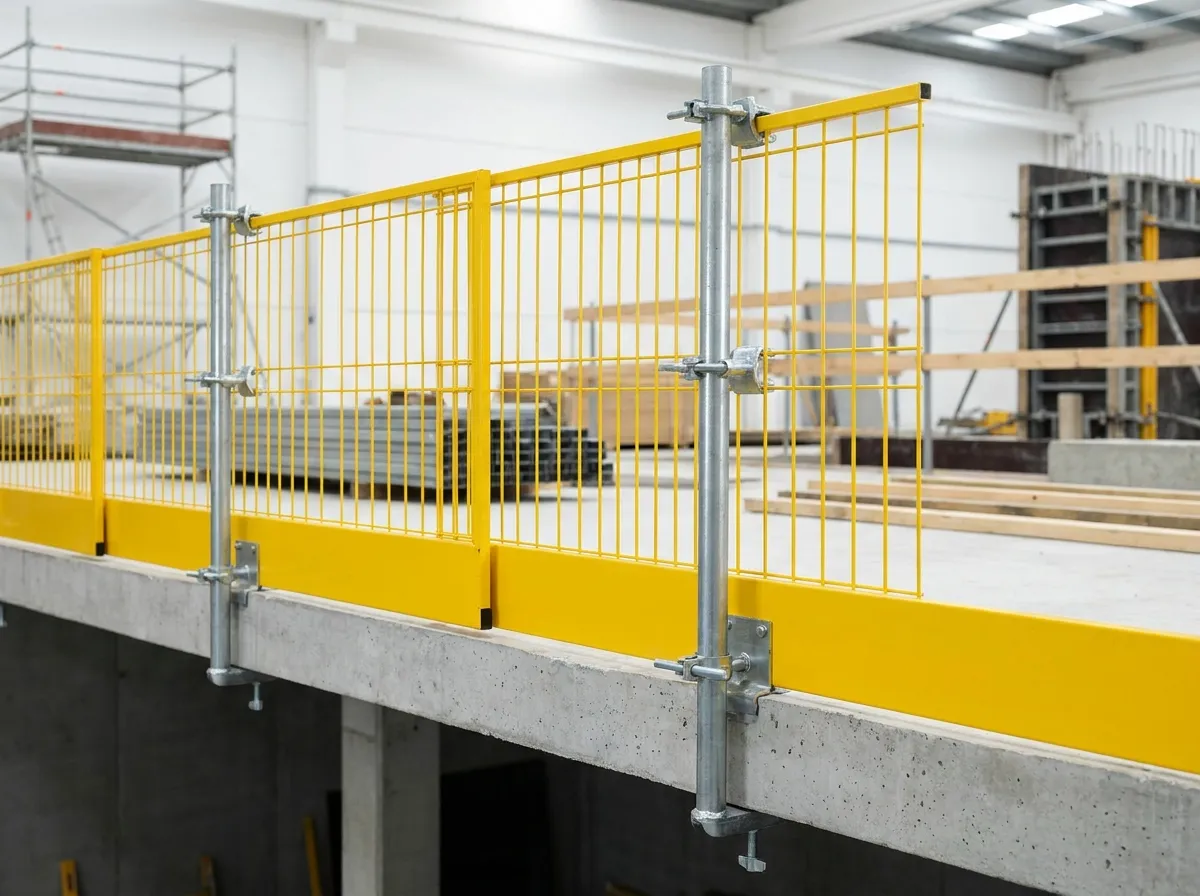
When is edge protection required?
Under OSHA 1926.501, fall protection is required for construction workers exposed to a fall of 6 feet (1.8 m) or more to a lower level. On open-sided floors, leading edges, and floor/roof openings, a compliant guard rail system is one of the primary acceptable methods.
What makes a guard rail compliant?
A conforming guard rail system (OSHA 1926.502) must have:
- A top rail 42 inches (±3 in) above the walking/working surface.
- A mid rail roughly halfway between the top rail and the surface.
- The ability to withstand a 200 lbf outward/downward force on the top rail without failing.
- Toe boards where there is a risk of tools or materials falling onto people below.
Why temporary edge protection?
Permanent rails aren't in place during the structural phase, yet that's when the edge exposure is highest. Temporary edge protection — guard rail panels with block, flat, or angle feet — gives you a fast, reusable, OSHA-aligned barrier that moves with the work.
- Block foot: free-standing, weighted — no drilling.
- Flat foot: bolt-down to the slab.
- Angle foot: clamps the slab edge — mount posts without penetrating the deck.
Bottom line
Edge protection is the most cost-effective passive fall-protection method on most slab-and-deck projects: install once at the leading edge, reuse across floors and projects, and keep crews protected without per-worker PPE friction.
Need help speccing a guard rail layout for your deck condition? Contact our team — we ship across the USA.
Need edge protection?
We supply guard rails, netting and fall-protection systems wholesale, shipped across the USA.
Browse products